ELECTRIC SCREENPRISON MANIFESTO
A downloadable prison_techbox
By MindApe for Manifesto Jam 2026
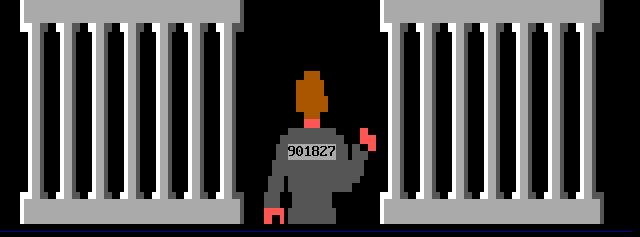
1 - Towards a total enchainment of the spirit
There is no such thing as gaming, but the power of the imagination to torture itself can it seems be increased without limit.
If physical suffering has its limits, psychic cruelties can through clever programming bypass any similar constraints.
The concept of gaming is a PR-gimmick, imposed on us by unseen psychic regulators, in order to keep us from the perverse, and subversive, mental intensities that come with full situational awareness.
Computer games are simply memory-killing devices.
By embodying the emotional impact of CHOICE within a strictly virtual container, they are effectively paralysis machines.
They are the arrestation of decision/history.
They are like pirate satellite dishes for karma (enjoying for free the mutations of cause and effect at a criminal distance).
Therefore computer games, to have any integrity whatsoever, should have the decency to model their own hopelessness.
Kojève speaks of the objective-concrete in painting, a method that disregards all formal requirements in favour of a single, subterranean compulsion.
A deposit of inner necessity… In a universe that, suffering entropy, is gradually running down?
Paradoxically, computer games may, by their very deceit, approach the ‘negentropic’ (reverse entropy).
You could say that they create a virtual something from nothing.
They embody, through absolute counterfeit, an impossible mechanism: the net new choice.
The most powerful games simulate the conventions of choice but actualize only a paralysis…
…Such that the action is introjected (through sublation) back into the world.
The content of the decision matters less than the pressurizing metastructure.
Paralysis / constraint is a fine passtime. It must play on the conventions of the medium to project an illusion of choice.
In short, computer games do not need to be about anything… Do not need to lie about anything.
And the more paralytic the better.
2 - Blank metal nothings
There is a school of good behaviour, characterized by a performative obedience to imperial uniformity.
Philip K. Dick calls it the BIP: the Black Iron Prison.
Everyone. Everything.
The Eerie Egregore behind all computer games is a prisonmaster.
All Computer Games Are Dungeons.
Computer games as oubliette, an extension of the horrible places of 18th-century gothic literature. Places of incarceration and suspense.
Is it any wonder they tend towards an (actual or implied) hypersadism?
When he first drew an invisible cage around a corpse-like Pope screaming in the void, Francis Bacon invented gaming.
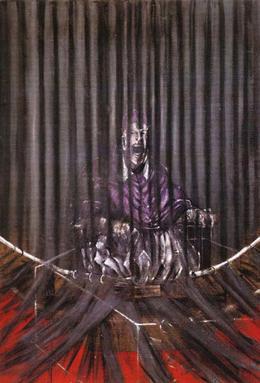
All games are cage simulators.
It is a question of quietly maximizing the cruelty-factor of a cage, in order to provoke a radical subconscious response.
Some games paper over the evil.
Others are quite explicitly torture chambers.
The most exquisite Torquemadean constructions of all are those delirious 90s screensaver-games.
After Dark (1991) radicalizes the blank screen such that it hallucinates, in stages, groping its way automatically, like a body in sleep paralysis, towards the possibility of movement.
Its various deranged modules, over each iteration, edge their way up to being game-like, and then collapse in on themselves.
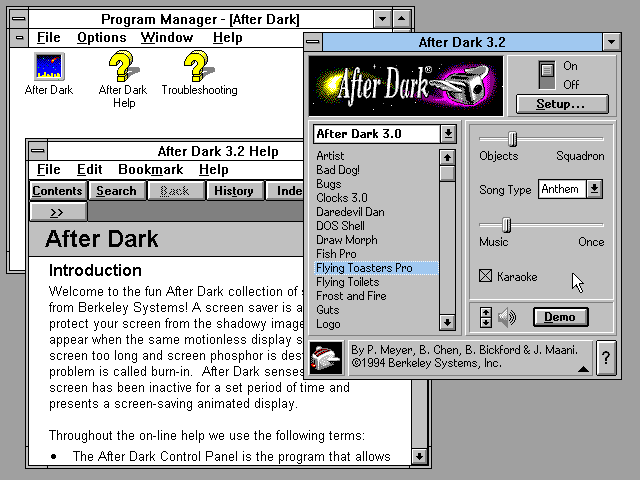
It is important for software to hijack the player’s attention and time. It is equally important they do so in full view of the public, so as to have the correct moral effect.
3 - On certain inescapable situations of electronic voids
Computer programs have nothing to do with person-to-person games; it is a false equivalence to compare the free adoption of constraints for the purposes of diversion to what is going on in the black iron box. Here is something far more frightening.
A scary hypothesis: is there a fundamental, almost epigenetic difference between someone who has played a computer game and someone who has not? Is the first play all it takes?
By playing any such trifle, have you inadvertently trapped yourself forever?
Are you now marked?
PKD sees salvation in an undercover invader named Zebra, the mimic-being who isn’t what it looks like, smuggled into an isekai-pseudoworld.
Zebra is the consciousness of the player.
The negentropic effect of a computer game could just maybe embody itself in the imagination of the player.
It is an opportunity to yet again acknowledge the sensation of “the theatrical (and joyless) pointlessness of everything” (Jacques Vaché).
A so-called computer game is simply a useless program. It highlights the fundamental inutility of computers in general.
If computer games are really just as TheCatamites says machines for the observation of one’s own thoughts, then gaming is effectively a subgenre of surrealism. In the first Manifesto of Surrealism, surrealism is defined as “Psychic automatism in its pure state, by which one proposes to express — verbally, by means of the written word, or in any other manner — the actual functioning of thought.”
As useless assemblages, such programs were given to us to make surrealist use of.
4 - How about kinetic dreaming?
In a real game, players follow voluntary constraints for diversion. To do this, they must consciously learn or adapt to the rules. In a computer game, constraints are already imposed. It is impossible to agree to, learn, or change them. These are not ‘rules’ in the sense of a game, then: the bars of a cage are not rules. They are physics.
Computer games are much closer to dreams than they are to actual games. In a dream, the subconscious programs the constraints, and the dreamer is simply thrown in with no choice whatsoever. Any choice taken in a dream is spurious, and under duress of a prison-logic. And yet the emancipatory power of dreams comes from their ability to intersect with the consciousness of waking life. They are negentropic in that, in a universe governed by a winding-down of cause and effect, they introduce as if from nowhere a new model of operation. The more intense the dream, the more powerful this effect becomes. We reserve a special word for the most intense dreams we are capable of having: nightmare. A dream so powerful it effectively becomes reality, and in so doing, makes its powers of domination visible to the dreamer in the form of unbridled fear. A computer game, or any useless program, can likewise bring to bear on reality the gesture of alternative modes of organization. In this sense, the more constrained, nightmarish, or terroristic a game is, the more potential it has to reverse the flow of psychic decay.
Another, more neutral word for prison is ‘medium’.
If, as McCluhan said, (any particular) medium is a message, then the meta-message of all media is: arrest them!
5 - The proliferation of minority softwares via bootsale or other clandestine markets
Deleuze and Guattari described the curious power of a ‘minor literature’ to subvert the dominant mode by embodying through their ethnic obscurity strange totalizing abilities. A minority writer (Kafka) speaks on behalf of an entire invisible stratum in the middle of an imperial conformity, and is thereby able to negate the givens of an official literary culture. How much more so for computer games, which make such a meal out of choice? The minority is able to show the absolute constriction of the mind when confronted with the pseudo-choices of the ‘role’. A majority-game is incapable, except by mistake.
Computer games are, like viruses, neither living nor dead. They are also, like viruses, subcellular mimics. They have adapted excellent forms of camouflage. They only reveal their true nature when infection results in symptoms, breakdowns, errors.
For psycho-structural reasons, minority-games take errors as their model. The re-integration of error and noise into the design patterns of majority-gaming is a cause of great concern for those who value the freedom of the imagination. Error-play must be earned.
The screensaver emerged from the horror of permanent screen damage on old CRT monitors. The computer left running and idle would eventually burn itself into the screen. There is an aesthetic lesson here somewhere.
***
- FONT: Sixtyfour.
- Images sourced (with some modification) from ‘BOOBV11 BBS’ and ‘Igormania 2000’ via DiscMaster.
- Francis Bacon’s Study after Velázquez (1950) pulled from Wikimedia Commons.
- After Dark screenshot comes from WinWorld.

***
Thanks to the voice from the pit himself, SHEM SHELLEY, for making this incredible home video edition.
Download
Comments
Log in with itch.io to leave a comment.
Bahaha. Literally if PkD wrote sword and sorcery...